Vehicle Configurator
2025A tool that helps car buyers find the right variant by choosing features, not filtering a list.
Context
Most car-buying experiences present a list of configurations and expect buyers to make sense of them. The typical flow is spec-first: here's everything that exists, good luck. For someone who doesn't already know the difference between a XLT and a Wildtrak, that list doesn't help. It just adds noise.
What I built
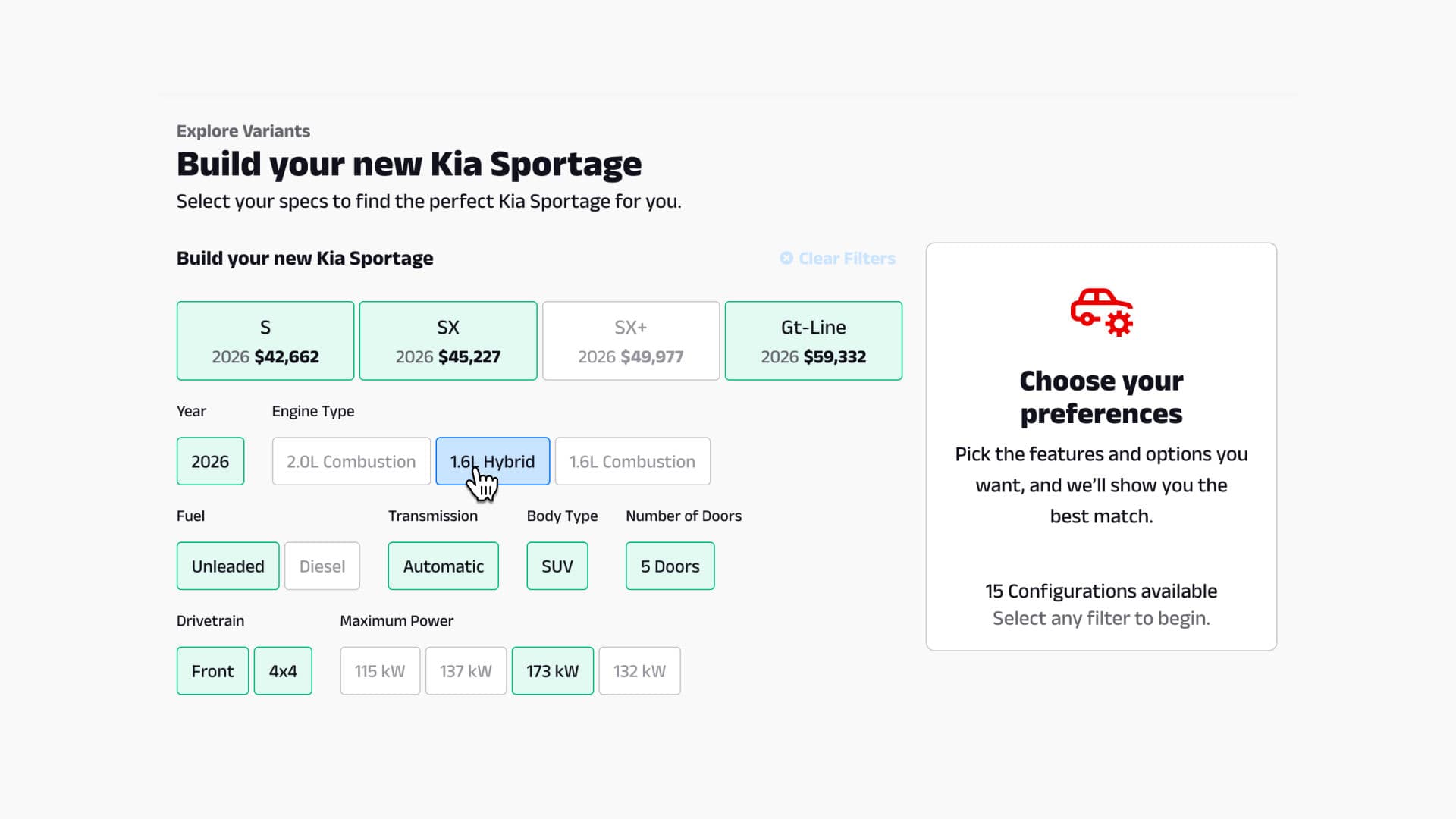
A proof of concept that flips the model. Instead of presenting every available configuration upfront, the tool asks buyers what features matter to them (things like drivetrain, body type, and fuel) and surfaces only the variants that match. The result is a much shorter, more relevant set of options that the buyer has effectively already filtered by their own priorities.
The interaction is built around constraint propagation. Hovering over any option previews which choices across the other specs would still be available, so buyers can explore compatibility before committing. Selecting an option immediately disables anything it rules out, keeping the remaining choices valid at every step.
After designing the UI in Figma I used a sample of our vehicle data to make a fully interactive version with real data to stress test the solution. The goal wasn't to design a UI but to validate the interaction model: does leading with preferences feel more intuitive than leading with specs?
Outcome
The concept demonstrated that a preference-first configurator is both technically straightforward and meaningfully different to use.